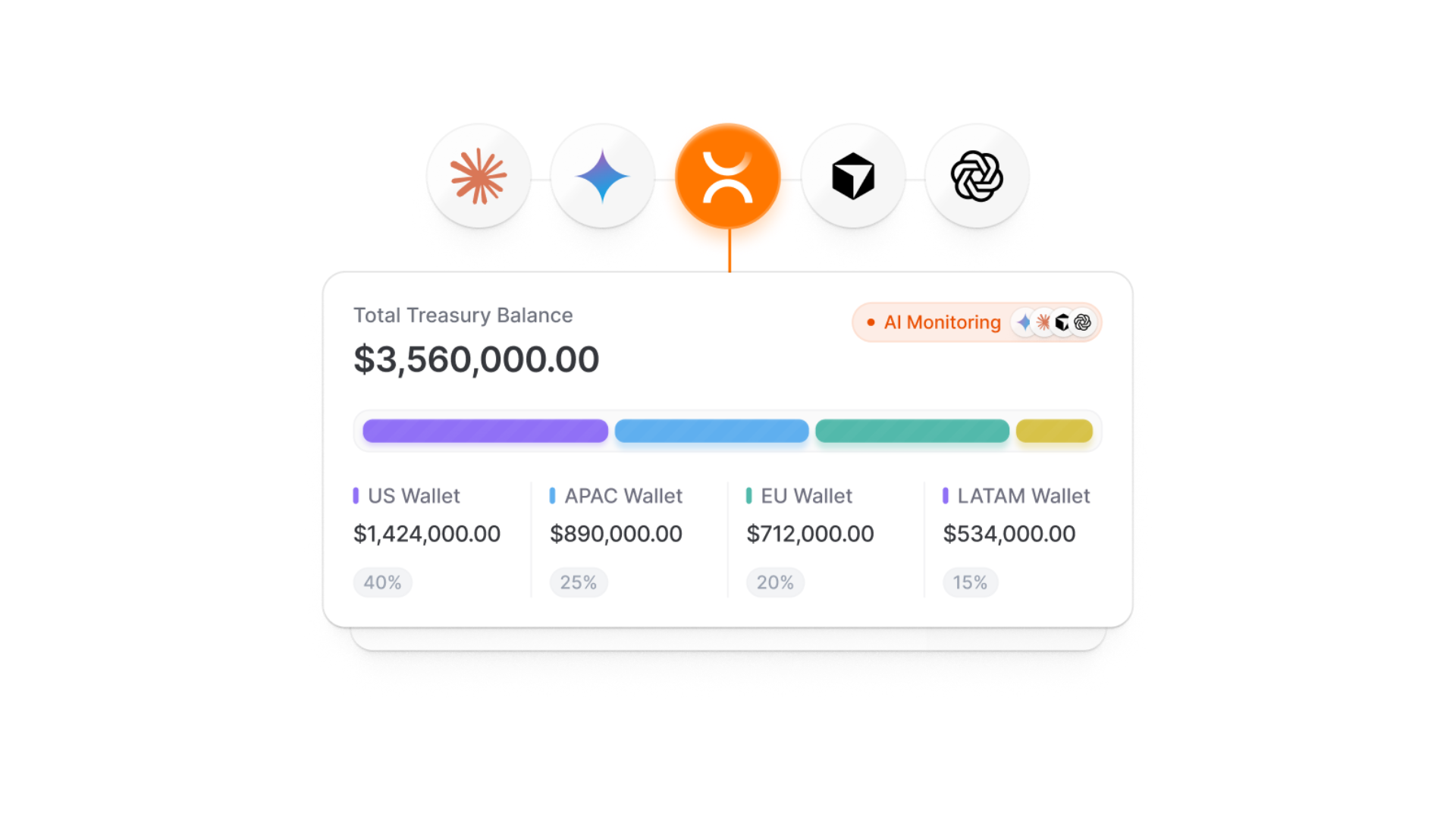
For years, the promise of AI in finance has outpaced the real utility experienced by treasury teams. This isn't for lack of a clear vision. CFOs and treasury teams can easily define their ideal state: an intelligent system that monitors liquidity across global entities in real time, flags counterparty risk before it crystallizes, automates regular payment and rebalancing flows, and surfaces actionable insights without requiring an analyst to manually compile a spreadsheet. What has been missing is the infrastructure and intelligence to make that vision trustworthy, secure, and operational.
With the launch of the N3XT MCP, that technology not only exists, but is accessible to clients today.
To bridge the gap between AI theory and treasury reality, two infrastructure challenges needed to be solved: how data is accessed (the governance challenge) and how data is settled (the data quality challenge).
Moving Beyond APIs
Historically, conversations about AI-assisted treasury management stall at data governance. Typical workflows have had to rely on manual data extraction: treasury teams download snapshots that become obsolete the moment they hit a desktop, then circulate them in ways that can risk revealing sensitive financial information to employees without appropriate clearance. In the worst cases, corporate data may be uploaded into unapproved AI tools, inadvertently exposing confidential information. The data governance risk is not a single point of failure; it is a slow accumulation of ungoverned workarounds.
Model Context Protocol (MCP) is the open-standard architectural solution to these challenges. Unlike traditional APIs, which often require custom development to manage data, MCP provides a standardized, secure bridge that connects live bank data with the intelligence of corporate AI agents to deliver holistic context to the business and treasury teams.
Consider a global enterprise facing an unexpected supply chain disruption. Through MCP, an AI agent could simultaneously read internal ERP inventory forecasts, cross-reference production delays, and securely query live bank account balances. Rather than an analyst spending hours pulling reports from disparate systems to build a quickly outdated picture, the AI agent synthesizes multi-system data instantly and presents optimized capital reallocation options.
The Data Quality Problem
Solving the data access layer only gets an organization halfway there. After all, AI outputs are only as reliable as the data foundation they are built on.
If an AI agent queries a legacy banking stack operating on batch-settlement cycles, it isn't analyzing reality; it's analyzing a delayed approximation of it. Traditional banking infrastructure relies on T+2 settlement cycles and overnight batch processing, which introduces a pain point every treasury team knows well: the gap between Balance and Available Balance.
Balance is what the ledger shows. Available Balance is the liquid capital you can deploy right now without risking settlement failure or overdraft penalties. Managing this gap typically forces businesses to hold a float of idle capital, reducing access to working capital. For AI-based analysis or agents executing real-time optimizations, the timing mismatch is a problem. If an agent attempts to deploy capital based on a balance that hasn't settled, the workflow breaks down entirely.
Real-time financial intelligence requires real-time data, and real-time data requires a banking model built around continuous, atomic settlement. When transactions are final the moment they occur, your stated balance is your available balance. That reliability transforms AI-based treasury management from a highly engineered approximation into a precise, action-oriented capability. That is the reality created by the N3XT MCP.
Shifting from Visibility to Autonomy
MCP on its own unlocks tremendous value by allowing teams to work natively within their own environments. But when MCP is combined with real-time settlement, the opportunity for genuine autonomous action becomes real. Treasury teams will not have to leave their systems to log into siloed banking portals just to execute standard operations.
Read capabilities allow AI agents to continuously monitor cash positioning across accounts/wallets, automate complex reconciliations, and flag and report anomalies before they manifest. Write capabilities, governed by existing user permissions, enable the execution of transactions and workflows as a response to identified scenarios or predefined thresholds. The agentic treasury will not just be a theoretical possibility, but as an operational reality.
The Industry Payoff: Finance at the Speed of Compute
We are moving past the era where money operates on a delay while the rest of the business moves instantly. The launch of N3XT MCP in combination with our existing near- instant-settlement infrastructure allows you to overcome traditional constraints.
The payoff for global business is not simply reduced manual labor and faster reporting. It is the establishment of financial workflows as a competitive advantage.